


Coronial Inquiry Versus Trial: Key Differences
A death can be the subject of both a coronial process and a criminal prosecution, yet the two proceedings are built to answer different questions. Confusing a coronial inquiry versus trial can lead people to expect a verdict from a coroner, or a full public reconstruction of events from a criminal court. Neither expectation is always justified.
For families, witnesses and the public, that distinction matters. One process examines how a person died and whether future deaths can be prevented. The other determines whether the prosecution can prove that an accused person committed a criminal offence.
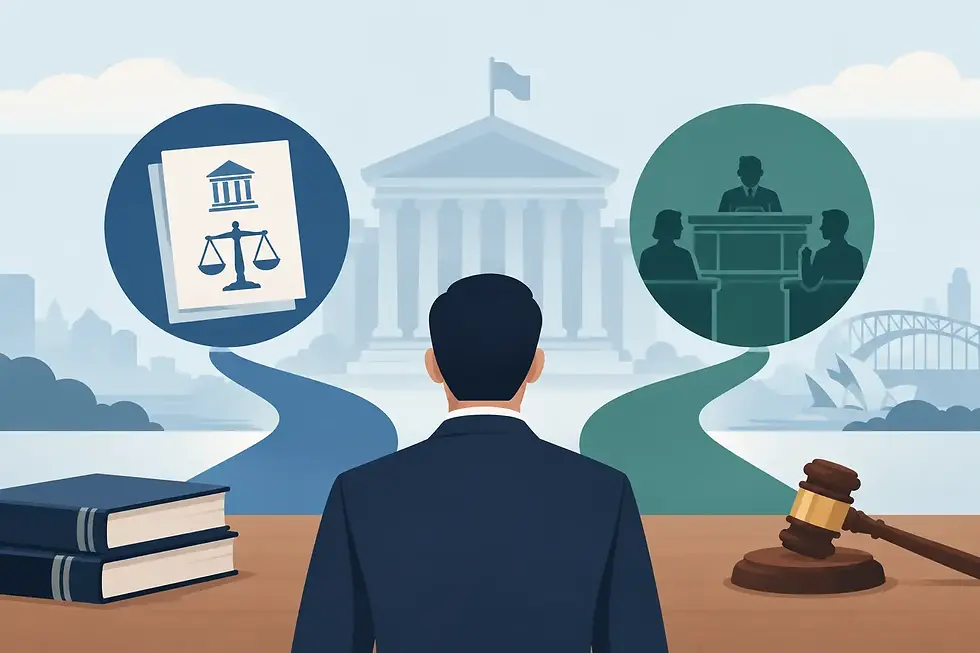
Coronial inquiry versus trial: the central difference
In Australia, the formal proceeding is generally called an inquest, although people often use the term coronial inquiry. A coroner investigates reportable deaths, and in some jurisdictions fires or disasters. The coroner's task is not to decide criminal guilt. It is to make findings about the identity of the deceased, and the medical cause, place, date and circumstances of death, so far as the evidence permits.
A criminal trial has a narrower but more consequential purpose. The prosecution alleges that a named person committed a defined offence. The accused is presumed innocent, and the prosecution must prove guilt beyond reasonable doubt. If that high threshold is not met, the accused must be acquitted.
This does not mean a coronial inquiry is less serious. It can expose investigative failures, test contradictory accounts, examine missed opportunities and place material on the public record. But it cannot substitute suspicion, concern or even a strong factual finding for a criminal conviction.
What question is each process trying to answer?
A coroner begins with the death itself. Was it natural, accidental, self-inflicted, caused by another person, or unable to be determined? What circumstances contributed? Were there systemic failures in health care, policing, child protection, custody, transport, workplace safety or emergency response?
The scope can be broad because the public interest is broad. An inquest may examine what happened before and after the death, decisions made by authorities, communications between agencies and whether known risks were acted upon. It may also consider whether recommendations should be made to reduce the risk of similar deaths.
A trial asks a different question: has the prosecution proved each legal element of a charge against this accused? A murder trial, for example, is not a general inquiry into every institutional failure surrounding a death. Evidence may be highly relevant to a family or to public confidence, but inadmissible or peripheral to the precise charge before the court.
That is why a trial can end without resolving every troubling feature of a case. It is also why an inquest may continue to matter where no person has been charged, where a prosecution has failed, or where the available evidence does not meet the criminal standard.
The standard of proof changes the outcome
The burden and standard of proof are among the most significant differences.
At a criminal trial, the prosecution bears the burden of proof. The jury, or judge in a judge-alone trial, must be satisfied beyond reasonable doubt. The standard reflects what is at stake: a conviction can remove liberty, damage reputation and carry lasting consequences.
Coronial findings are made under a civil standard, commonly described as the balance of probabilities. In practice, the seriousness of an allegation and the quality of available evidence remain critical. A careful coroner does not make a grave finding lightly. Findings must be based on evidence, not speculation.
The distinction can produce outcomes that appear inconsistent but are legally coherent. A coroner may find that a death was likely caused by another person, yet there may be insufficient admissible evidence to prosecute anyone. Equally, an acquittal at trial means guilt was not proved beyond reasonable doubt. It does not necessarily answer every factual question that concerned the community.
How evidence is handled
A criminal trial is an adversarial contest conducted under strict rules. Evidence must be relevant and admissible. Witnesses give evidence under oath and are cross-examined. The defence can challenge reliability, identification evidence, forensic opinions, police conduct and the continuity of exhibits. The judge must ensure fairness to both sides.
A coronial inquiry is also evidence-based and witnesses can be closely questioned, but the process is usually more investigative in character. The coroner can call for records, hear from experts, require explanations from agencies and explore lines of inquiry that may not fit neatly within the boundaries of a criminal charge.
That broader reach is valuable, but it has limits. Hearsay, untested assumptions and incomplete police material do not become reliable merely because they are aired in an inquest. The central investigative question remains the same: what does the evidence establish, and what remains unknown?
For anyone reviewing a contested case, the source of a claim is as important as the claim itself. Was it a sworn account? A contemporaneous record? A forensic opinion based on disclosed material? A later recollection? Was it tested by another party? These questions apply in both forums.
Can a coroner name a person responsible?
This is where public discussion often becomes imprecise. Coronial legislation differs between states and territories, and the powers available to a coroner depend on the jurisdiction and facts of the matter. Generally, a coroner is not there to determine criminal liability or to conduct a trial by public opinion.
A coroner may make findings about the circumstances of death, including whether the evidence supports an unlawful killing. Depending on the jurisdiction, findings may identify conduct or persons where that is necessary and supported by the evidence. Procedural fairness is essential, particularly where an adverse finding may affect a person's reputation or legal position.
A coronial finding does not make someone criminally guilty. Nor does it impose a sentence. Where evidence indicates a possible indictable offence, a coroner may refer material to police, the Director of Public Prosecutions or another appropriate authority. Whether charges follow is a separate decision, made under criminal law and prosecutorial guidelines.
Why an inquest may follow, precede or sit apart from a trial
The sequence is not fixed. Police may investigate a death first, a person may be charged, and an inquest may be delayed while criminal proceedings run their course. This protects the fairness and integrity of the trial process.
In other matters, an inquest is held because no charge has been laid. It may identify gaps requiring further investigation, reveal that key evidence was never pursued, or prompt a referral for review. A recommendation can also address systemic risk even where no criminal conduct is established.
An inquest after a trial can be particularly important where the trial did not, and could not, examine broader questions. The coroner may consider whether agencies responded adequately, whether the investigation met proper standards and whether changes are needed. That does not permit the coronial court to simply retry an acquitted person. The legal rights of individuals remain central.
What families and the public should realistically expect
A criminal trial can provide a clear verdict, but not always a complete explanation. An inquest can provide a detailed public account, but not always a culprit. Both processes can be lengthy, emotionally difficult and dependent on evidence gathered years earlier.
The most useful approach is to read findings, transcripts, exhibits and reasons with discipline. Separate proven facts from allegations. Separate a witness's account from an accepted finding. Pay attention to what was not tested, what evidence was unavailable and whether recommendations were later implemented.
That is where real accountability begins. A coronial inquiry and a trial are not competing versions of justice. They are different legal tools, each with its own limits. When a death remains contested, the task is to keep asking the right question of the right process, and to keep the evidence at the centre of the case.


Comments