

True Crime Needs Evidence, Not Spectacle
A crime scene is not a plot device. It is the starting point for a chain of decisions: what police preserve, what witnesses recall, what exhibits are tested, what is missed, and what a jury is ultimately asked to decide. That is where true crime either becomes useful or becomes noise.
For people following contested cases, the real question is rarely whether a story is compelling. It is whether the account matches the evidence. Does the timeline work? Was a witness statement tested against known facts? Did investigators pursue reasonable alternatives? What did the court actually hear, as distinct from what later commentary says it heard?
Those questions can be uncomfortable. They should be. Criminal justice carries enormous consequences for victims, families, accused people and the wider public. It deserves more than a dramatic retelling.
True crime is strongest when it tests the record
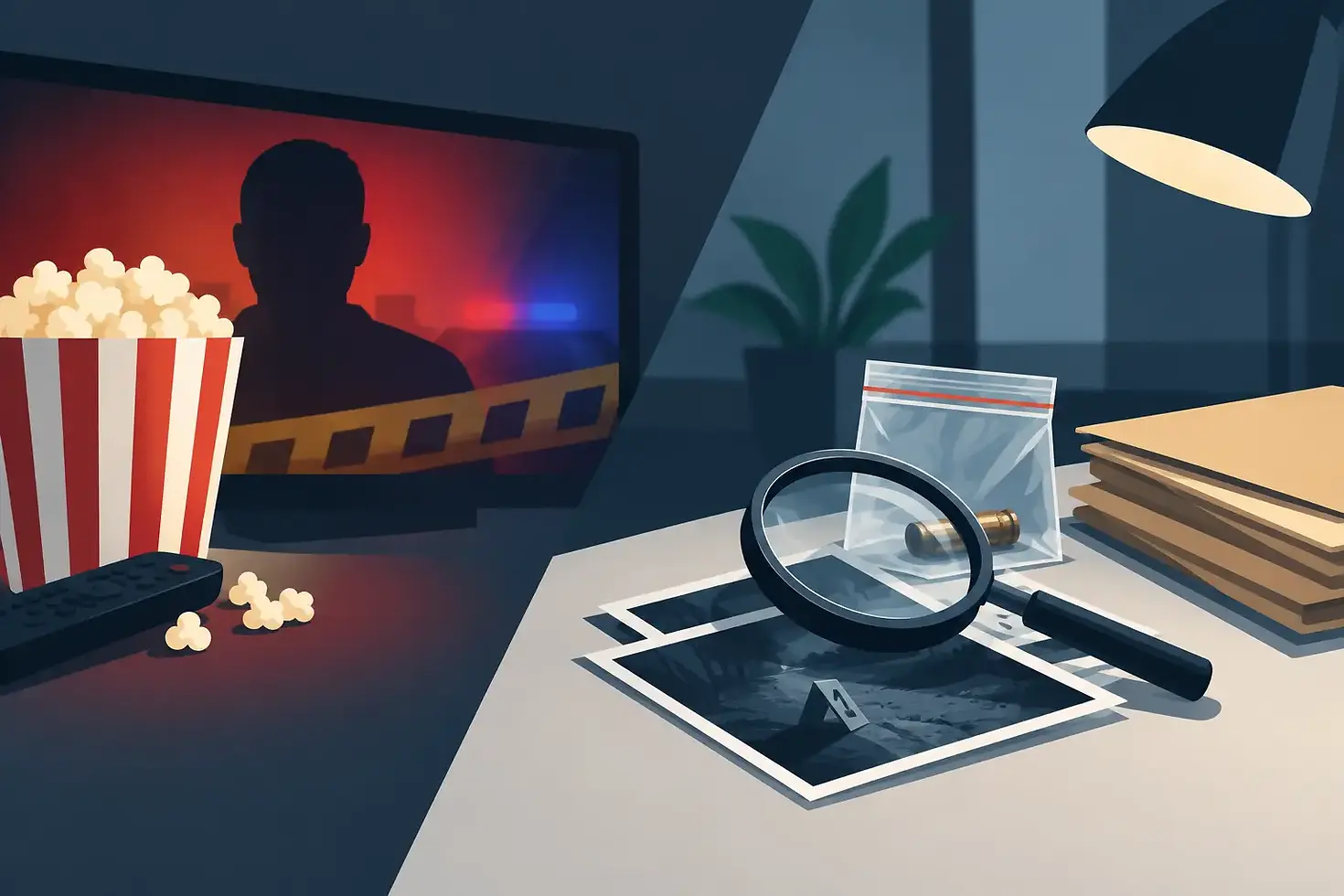
There is a clear difference between crime entertainment and case analysis. Entertainment is built around pace, revelation and reaction. It may use ominous music, selective interviews and a final twist to hold attention. Investigation is slower. It returns to documents, timings, photographs, witness accounts, exhibits, forensic reports and court transcripts. It accepts that some questions may remain unresolved.
That distinction matters most in cases involving an unsolved death, a disputed conviction or allegations of investigative failure. A popular narrative can harden long before all the material has been examined. Once it does, information that does not fit can be ignored, dismissed or reshaped to protect the story people prefer.
A proper review works the other way around. It begins with what can be established and builds outward. The evidence may support the accepted account. It may expose weaknesses in it. Either outcome is preferable to certainty manufactured for an audience.
This does not mean every odd detail proves misconduct or innocence. Investigations are conducted by people, often under pressure and with incomplete information. Mistakes can occur without conspiracy. Equally, an official conclusion is not beyond scrutiny simply because it is official. The task is to identify the issue, locate the source material and ask whether the conclusion follows.
The timeline is often where a case stands or falls
In serious investigations, time is not background detail. It is evidence. A timeline can reveal whether a person had the opportunity to act, whether a witness could have seen what they described, how long a vehicle journey really took, or whether a claimed sequence is physically possible.
The strongest timelines separate fact from inference. A confirmed phone call, a receipt, a sighting supported by a statement, a laboratory result and a television report should not all be treated as equal. Each has a source, a level of reliability and a context. The public needs to see those differences.
For example, a witness may sincerely remember an event but be wrong about the hour, the weather or the order in which things happened. Memory is not a recording. It can be influenced by later conversations, media reporting and repeated questioning. That does not make witnesses dishonest. It means their evidence must be assessed carefully, alongside independent material.
Timelines also expose gaps. A gap is not automatically proof of wrongdoing, but it is a lead. Why is there no account of a particular period? Was a relevant person spoken to? Was available CCTV, phone data or physical evidence obtained before it was lost? Did investigators record why a possible line of inquiry was not pursued? Those are practical questions, not internet speculation.
Documents matter more than confident commentary
A confident voice can make a weak claim sound settled. That is why serious case analysis should direct attention back to primary and near-primary material: court judgments, sworn evidence, police records where lawfully available, inquest findings, forensic reports and contemporaneous documents.
Media reporting has value, particularly where it captures events or statements close to the time. But it has limits. Headlines compress complexity. Reports can rely on partial information. A correction may receive far less attention than the initial allegation. The same caution applies to books, podcasts and documentaries, including those that make persuasive arguments.
The useful question is simple: what is this claim based on? If the answer is vague, the claim should remain tentative. If the answer is a transcript, exhibit, official finding or properly identified witness account, the reader can assess it with greater confidence.
Respect for victims requires accuracy
Victims and families are often used as emotional shorthand in true crime. Their photographs, grief and private lives can be placed at the centre of a story without adding a single fact to public understanding. That approach may attract attention, but it does not honour anyone.
Respect is shown by precision. Use names correctly. Distinguish allegation from proof. Do not turn a victim into a stereotype, or an accused person into a villain before the evidence has been tested. Avoid publishing gratuitous material merely because it is confronting. Explain why a fact matters to the investigation.
This standard is especially important when discussing children, sexual violence, family violence and unresolved disappearances. Public interest is not the same as public curiosity. A detail may be widely discussed and still be unnecessary, unreliable or needlessly harmful.
Accuracy also protects the public’s ability to care about a case for the right reasons. When a case is reduced to shock value, people remember the most lurid allegation rather than the evidentiary issue that needs examination. When it is presented carefully, they can see where accountability may be required.
Scrutiny of police work is part of justice
Most investigators understand that a criminal investigation must be capable of review. Major decisions should be recorded. Exhibit handling must be traceable. Witnesses need to be approached fairly. Alternative hypotheses must be considered, particularly before a case narrows around one suspect.
Reviewing police work is not anti-police. It is a recognition that investigative powers are significant and that errors can have permanent consequences. A missed statement, an untested exhibit or a flawed assumption can alter the direction of an entire case. In a prosecution, the cost may be a wrongful conviction. In an unsolved matter, it may be the loss of a viable lead.
The same principle applies to criticism. It should be specific. Rather than claiming an investigation was simply “botched”, identify what was done, what standard or opportunity is said to have been missed, and why it matters. Was a scene inadequately preserved? Was a key account never tested? Was expert evidence overstated? Was disclosure incomplete? Specific criticism can be answered. Broad accusation rarely assists anyone.
For audiences examining Queensland cases and other Australian matters, court processes and coronial findings provide essential context. A finding may be limited by the question before the court. An inquest is not a criminal trial. An appeal may address legal error without deciding every factual dispute. Knowing the function of each process prevents readers from asking one document to do work it cannot do.
The public can contribute without becoming investigators
Public attention can keep a case visible, support calls for records to be examined and encourage careful reporting. It can also produce misidentification, harassment and false claims. The line is crossed when interest becomes interference.
A responsible follower checks dates and sources before sharing material. They do not contact witnesses, relatives, jurors or suspects for answers. They do not name people who have not been publicly identified through reliable and lawful reporting. They recognise that a social media theory, however neatly packaged, is not evidence.
There is still a meaningful role for the public. Read beyond the headline. Compare accounts. Notice where a claim changes. Support work that publishes timelines, court material and clearly sourced analysis. Ask whether a case has been presented with enough context to let you form an informed view.
At Graeme Crowley Investigates, that approach means treating a case file as something to be examined, not exploited. The purpose is not to promise certainty where none exists. It is to put the relevant material in order and keep the central questions in view.
The best true crime work leaves the audience more careful than when it found them. It makes people less willing to accept a convenient narrative, more alert to the difference between proof and assertion, and more conscious of what justice demands from every investigation.



Comments