

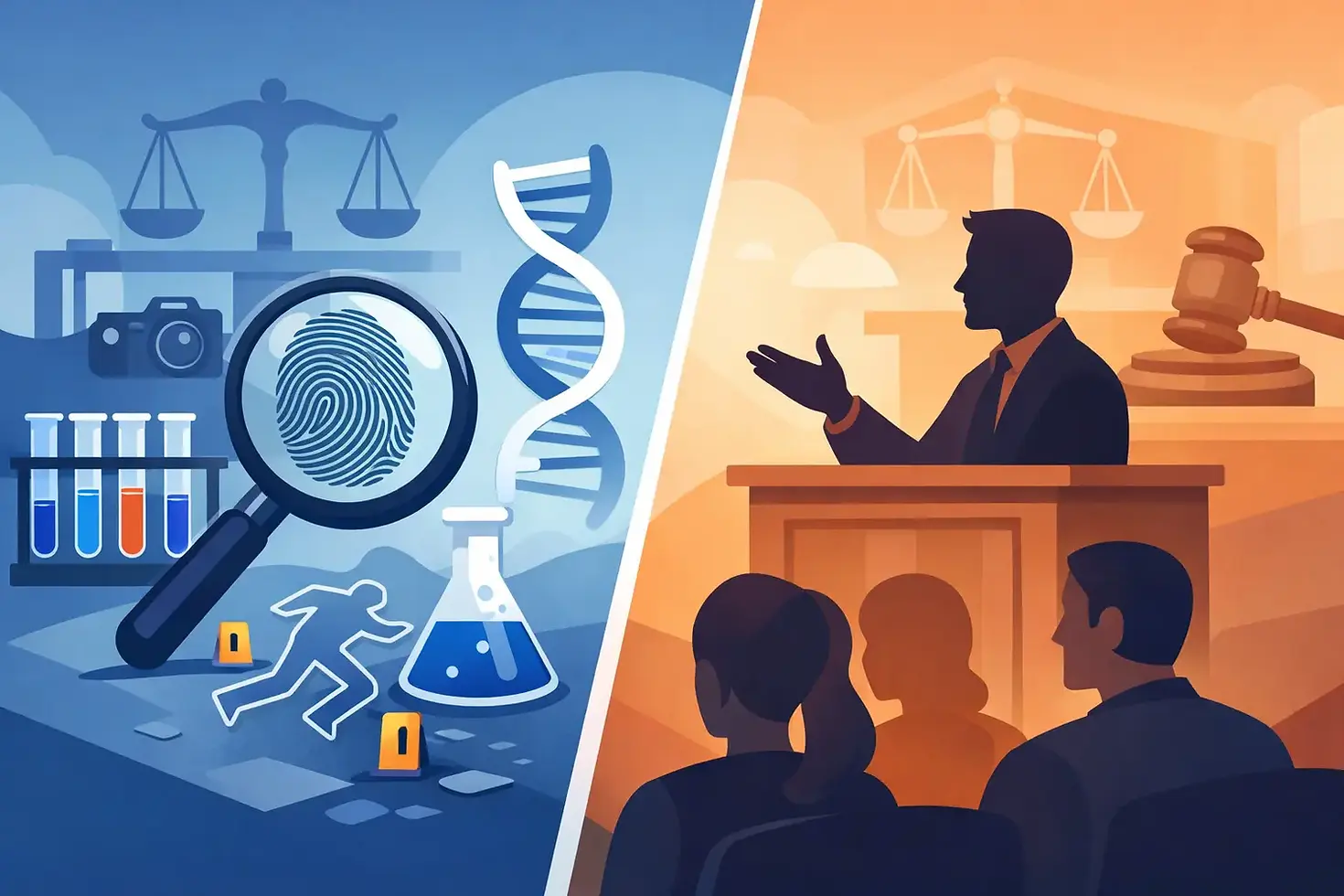
Forensic Evidence Versus Witness Testimony
- graeme5353
- Jun 13
- 6 min read
Ask any experienced investigator what causes the most argument in a contested case and the answer is usually the same: people place too much faith in one form of proof. The debate over forensic evidence versus witness testimony is often framed as science against memory, fact against human error. Real cases are rarely that simple.
A criminal investigation is built by assembling fragments. Some come from a crime scene - blood, fibres, fingerprints, DNA, tool marks, mobile data. Others come from people - what they saw, heard, believed, remembered, or later reconstructed. Neither category is automatically superior. Each can be compelling. Each can also mislead.
Why forensic evidence versus witness testimony is not a simple contest
Courts do not decide cases by awarding points to science or to eyewitnesses. They assess reliability, relevance, continuity, timing, and whether one piece of evidence is supported by another. That matters because forensic material can appear objective while still being badly collected, contaminated, misinterpreted, or overstated. Witness evidence can appear shaky while turning out to be highly accurate on a crucial point.
This is where many public discussions go wrong. A jury may hear that DNA was found, and assume the case is effectively over. But DNA can show contact without proving when that contact occurred, how it occurred, or what offence, if any, took place. Likewise, a witness may seem uncertain under cross-examination, yet still be right about the identity of a vehicle, a conversation, or a sequence of events.
The proper question is not which type of evidence wins in the abstract. The proper question is what this particular evidence proves, and what it does not.
What forensic evidence does well
Forensic evidence is valuable because it can tie people, places, objects, and events together in ways that are less vulnerable to bias than ordinary recollection. If blood is located in a suspect’s vehicle, if fibres from a victim’s clothing are found in a house, or if mobile records place a device in a location at a relevant time, that can materially narrow the field of possibilities.
Good forensic work also helps test stories. If a suspect says they were never in a room, but their fingerprint is on an interior surface that would not be touched casually, the statement becomes difficult to maintain. If a witness claims an assault happened in one location, but the blood pattern and injury evidence are inconsistent with that account, investigators need to rethink the narrative.
This is one reason forensic material carries weight with courts and juries. It can act as an independent check on human accounts. It may also survive the passage of time better than memory, particularly in cold cases where witness recall has faded or become contaminated by media coverage and repeated discussion.
The limits of forensic proof
Still, forensic evidence is not self-executing. It requires competent collection, secure continuity, proper testing, and careful interpretation. A sample collected badly is not redeemed by a sophisticated laboratory. A fingerprint comparison is only as strong as the examiner’s method and the quality of the print. DNA, often treated as the gold standard, does not narrate events. It places biological material in context only when investigators and courts understand transfer, persistence, background presence, and contamination risk.
This is where miscarriages of justice can begin. A scientific finding may be presented more strongly than the underlying data allows. A prosecution may imply certainty where the result is really probabilistic. A defence may attack the science generally without confronting the specific strength of the result. Either way, the fact-finder can be left with a distorted picture.
What witness testimony does well
Witness testimony fills gaps that physical evidence often cannot. A witness can describe behaviour, urgency, threats, relationships, arguments, intoxication, demeanour, and timing. They may explain why a person was fearful, why a meeting took place, or why a later act was out of character. That sort of evidence can be critical in proving motive, opportunity, and intent.
In many cases, witnesses are the reason police know where to look at all. A witness may place a vehicle on a road, identify a person near a scene, or recall a detail that appears trivial at first but later aligns with mobile records or forensic findings. Without that human account, the physical trail may never be found.
Witnesses are also central in cases where forensic evidence is sparse or absent. Not every crime produces usable DNA or fingerprints. Outdoor scenes degrade. Time passes. Items are moved, washed, burned, or discarded. In those circumstances, testimony may be the only route to reconstructing what happened.
The weaknesses in witness memory
None of this changes a hard truth. Human memory is not a recording. It is selective, reconstructive, and vulnerable to suggestion. Stress can sharpen some details and erase others. Lighting, distance, alcohol, fear, assumption, and elapsed time all matter. So does the way police ask questions.
An honest witness can be mistaken. That is one of the most dangerous features of witness testimony. A liar can be exposed by contradiction, but a sincere witness who is wrong can be deeply persuasive. They may present with confidence, repeat their account consistently, and still be mistaken about identity, timing, or sequence.
This is why identification evidence demands caution. Cross-racial identification issues, fleeting observations, poor viewing conditions, and suggestive procedures can all produce error. History is full of convictions built around confident eyewitnesses who were later proven wrong.
How courts weigh forensic evidence versus witness testimony
The strongest cases are not built on one or the other. They are built on convergence. If a witness says a suspect entered a property at a certain time, CCTV places the person nearby, mobile data supports movement, and forensic material links them to the scene, the combined case is stronger than any single strand.
Equally, where evidence conflicts, courts look closely at why. If several witnesses agree on an event but the physical evidence points elsewhere, that inconsistency cannot be brushed aside. It may mean the witnesses are wrong. It may mean the forensic interpretation is wrong. It may mean the event happened differently from either side’s theory.
Experienced investigators do not ask whether they prefer science or people. They ask which evidence is fixed, which is uncertain, and which assumptions are doing too much work. That discipline matters in disputed prosecutions and in reviews of old convictions.
When one type of evidence should carry more weight
There are cases where forensic material should plainly dominate. If the issue is whether a firearm discharged, whether a document was altered, or whether biological material came from a particular individual, technical evidence may be central. Even then, interpretation remains critical.
There are also cases where witness testimony deserves substantial weight. Domestic violence matters, grooming cases, and offences occurring in private often turn on conduct that leaves little physical trace. To dismiss witness accounts simply because they are not scientific would be a serious error.
The real discipline is matching the evidence to the issue. Identity, timing, presence, intent, and mechanism are not all proved in the same way. One category of evidence may answer one question and be useless on another.
The investigative lesson
At Graeme Crowley Investigates, one recurring theme in contested cases is not merely bad evidence. It is bad weighting of evidence. Investigators, lawyers, media, and the public can become fixated on a single dramatic point while ignoring the broader evidentiary picture.
A witness statement should be tested against known facts, not accepted because it sounds convincing. Forensic findings should be scrutinised for collection method, continuity, competing explanations, and the possibility of innocent transfer. If either is treated as beyond challenge, the investigation starts drifting from proof into assumption.
That is why case review matters. It slows the process down. It asks whether timelines fit, whether exhibits were handled properly, whether recollections changed over time, and whether the court was given a fair picture of uncertainty as well as certainty.
The healthiest approach to forensic evidence versus witness testimony is sceptical but not cynical. Forensic science can illuminate the truth. Witnesses can too. Both can also point in the wrong direction when handled poorly, overstated, or stripped from context.
If you want a better understanding of any criminal case, start here: do not ask which side sounds stronger in theory. Ask what each piece of evidence actually proves, what it cannot prove, and whether the whole case still stands when the assumptions are taken away.


Comments